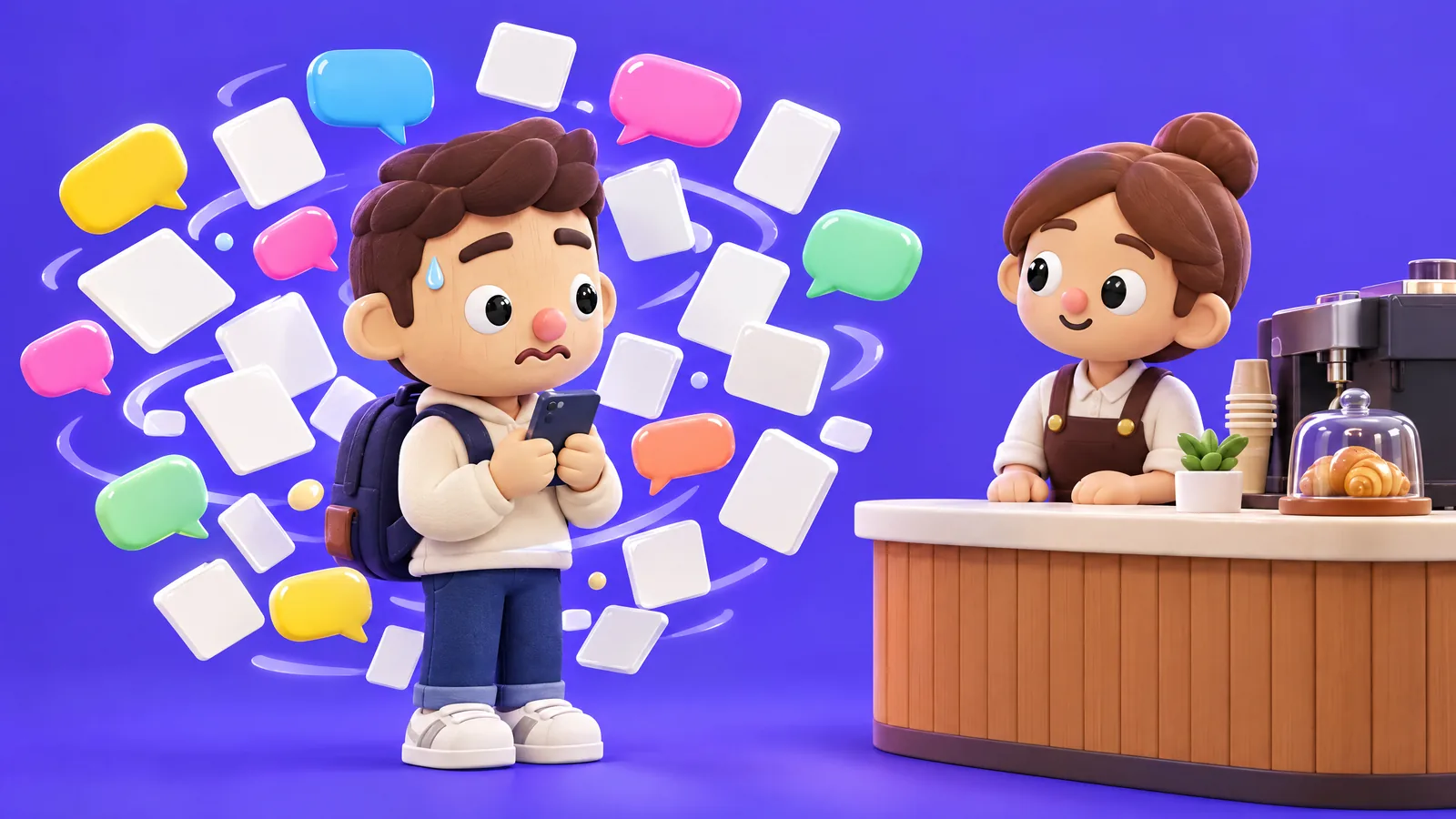
You've completed your Duolingo tree. You know how to conjugate verbs. You can translate sentences. Your streak counter shows 500 days of consistent practice.
Then someone asks you ¿De dónde eres? and you freeze.
You know what each word means. De means "from." Dónde means "where." Eres is "you are." Your brain processes the translation: "Where are you from?" You know the answer. But the words won't come. You stammer. You apologize. You switch to English.
This isn't a failure of effort. You've put in the hours. This is a failure of method.
The vocabulary-to-fluency myth
Traditional language learning apps operate on a simple premise: memorize enough words and speaking will follow naturally. Learn 2,000 words and you'll understand 80% of everyday conversation. Learn 5,000 words and you're functionally fluent.
The math is correct. The premise is wrong.
Vocabulary size and speaking ability are not the same skill. One measures passive knowledge—recognition when you see or hear a word. The other measures active production—retrieving and using words in real-time while constructing grammatically correct sentences under pressure.
The gap between these skills is massive. And vocabulary-first learning does nothing to close it.
What actually happens when you speak
Real conversation requires simultaneous execution of multiple cognitive tasks:
- Retrieve the correct word from thousands of possibilities
- Apply proper conjugation based on tense, person, and mood
- Construct grammatically valid sentence structure
- Pronounce words clearly enough to be understood
- Monitor what you're saying for errors
- Listen to the other person's response
- Process their meaning while formulating your next statement
You have 600 milliseconds to do all of this. That's the average pause length in natural conversation before silence becomes awkward.
Vocabulary drills train exactly one of these skills: word retrieval. They don't train retrieval speed. They don't train conjugation under pressure. They don't train pronunciation. They don't train error monitoring or real-time processing.
Expecting vocabulary study to produce speaking ability is like expecting pushups to make you a better tennis player. The strength helps, but without practicing the actual skill—racket control, footwork, shot selection—you'll lose every match.
The recognition-production asymmetry
Most language learners experience a 3:1 or 4:1 ratio between words they recognize and words they can produce in conversation.
This asymmetry exists because recognition is easier than production. When you see mesa in a sentence, context helps. The surrounding words narrow down the meaning. Your brain pattern-matches against similar words you've seen before. You only need to retrieve the English translation.
Production reverses the task. You need to express "table" in Spanish. No context clues. No multiple choice. Just your memory and 600 milliseconds. If the word doesn't surface immediately, the conversation moves on without you.
Vocabulary apps train recognition. They show you mesa and ask you to select "table" from four options. Or they show you "table" and ask you to type mesa. Both tasks use visual cues, unlimited time, and no pressure.
Conversation has none of these advantages.
Why Duolingo users can't speak
Duolingo is effective at what it's designed to do: build vocabulary through spaced repetition and gamified engagement. It keeps users coming back. It teaches thousands of words. It makes learning feel like progress.
But Duolingo optimizes for daily engagement, not speaking ability. The exercises—tap matching words, translate sentences, fill in the blanks—train pattern recognition, not real-time production.
The result is predictable: users complete their tree, hit 500-day streaks, and discover they still can't order coffee in their target language. They know the words. They've "learned" the grammar. But they haven't practiced the skill that matters: speaking.
This isn't unique to Duolingo. Rosetta Stone, Babbel, Memrise—all vocabulary-first apps produce the same outcome. The method, not the brand, is the problem.
7 methods that actually build speaking ability
If vocabulary drills don't work, what does? Based on second language acquisition research and analysis of 1,000+ language learners, these methods consistently produce conversational ability:
Conversation practice with immediate feedback
The most effective method is also the most obvious: practice speaking and get corrected in real-time. This trains all the cognitive skills conversation requires—word retrieval under pressure, grammatical construction, pronunciation, error monitoring.
Traditional methods use language exchange partners or tutors. The challenge is cost (tutors) or quality (exchange partners who can't explain grammar rules). AI conversation tools solve both problems by providing unlimited practice with instant, accurate feedback at a fraction of the cost.
Scenario-based practice
Practicing isolated phrases out of context is nearly useless. "Where is the library?" serves no purpose if you're never looking for a library.
Effective practice uses realistic scenarios: ordering at a restaurant, asking for directions, making small talk, handling workplace conversations. Context provides memory hooks. Repetition builds automatic responses for common situations.
Spaced repetition of spoken output
Spaced repetition works for vocabulary. It works better for speaking when you repeat spoken phrases, not written translations.
Instead of seeing "hello" and typing hola, see a situation ("greet someone formally") and speak the phrase aloud. Your brain encodes the motor patterns for pronunciation along with the words themselves.
Error correction focused on communication
Not all errors matter equally. Pronunciation errors that block comprehension matter more than grammatical errors that don't. "I go to store yesterday" is understood despite wrong tense. "I [unintelligible mumble] to store yesterday" is not.
Effective feedback prioritizes errors by impact on communication. Fix pronunciation first, then word choice, then grammar. This builds confidence while maintaining correctness.
Comprehensible input at your level
Reading and listening to content slightly above your current level (i+1 in acquisition theory) accelerates learning. The key is "slightly above." Too easy and you don't progress. Too hard and you can't understand enough to learn.
Most learners consume content that's either too simple (children's books) or too complex (news articles). Adaptive content that adjusts to your level fills this gap.
Daily speaking practice (15-20 minutes minimum)
Frequency beats duration. 15 minutes of speaking practice daily produces better results than 2 hours once a week. Speaking ability requires building motor patterns and recall speed. These require consistent repetition.
Most Duolingo users spend 5-10 minutes per day on vocabulary drills. The same time spent on conversation practice would produce 3x faster progress toward actual fluency.
Focus on high-frequency phrases, not comprehensive coverage
You don't need to know 10 ways to say "beautiful." You need automatic recall of the 100 phrases that account for 50% of everyday conversation: greetings, common questions, transitional phrases, simple responses.
Master these phrases to the point where they're automatic. Then expand vocabulary. Most learners do the opposite—learn thousands of words they'll rarely use while fumbling through basic exchanges.
The conversation-first alternative
If you've spent months on Duolingo and still can't speak, switching methods isn't admitting failure. It's recognizing that vocabulary-first learning solves the wrong problem.
You don't have a vocabulary problem. You have a speaking problem.
Vocabulary apps like Duolingo build recognition. Conversation-first tools like Nomino build production. Many learners use both: Duolingo for vocabulary breadth, conversation practice for speaking ability.
But if your goal is speaking—actually communicating in real situations, not translating sentences on a screen—then conversation practice should be your primary method, not a supplement.
What to expect
Most users who switch to conversation-first practice report noticeable improvement within 30-60 days of daily 15-minute sessions. Not fluency. But functional conversational ability: ordering food, asking questions, handling common scenarios without freezing.
The timeline to conversational fluency (holding extended conversations on varied topics) is typically 6-9 months with consistent practice. That's 3x faster than vocabulary-first methods because you're training the actual skill you want to acquire.
Will you make mistakes? Constantly. Native speakers make mistakes. The goal isn't perfection. The goal is communication.
Stop memorizing. Start communicating.
You've proven you can commit to daily practice. You've built the habit. You've put in hundreds of hours.
Now redirect that effort toward the skill that actually matters: speaking.
Read fewer flashcards. Have more conversations. Make more mistakes. Get more feedback. Practice retrieving words under pressure instead of recognizing them in multiple-choice exercises.
Your vocabulary won't disappear. You've built a foundation. Now build the skills to use it.
That's what fluency actually is: not knowing every word, but using the words you know to communicate effectively in real situations.
Memorization got you here. Conversation will get you the rest of the way.
Written by the Nomino team. We engineer confidence through AI-powered conversation practice—3x faster than traditional methods.